
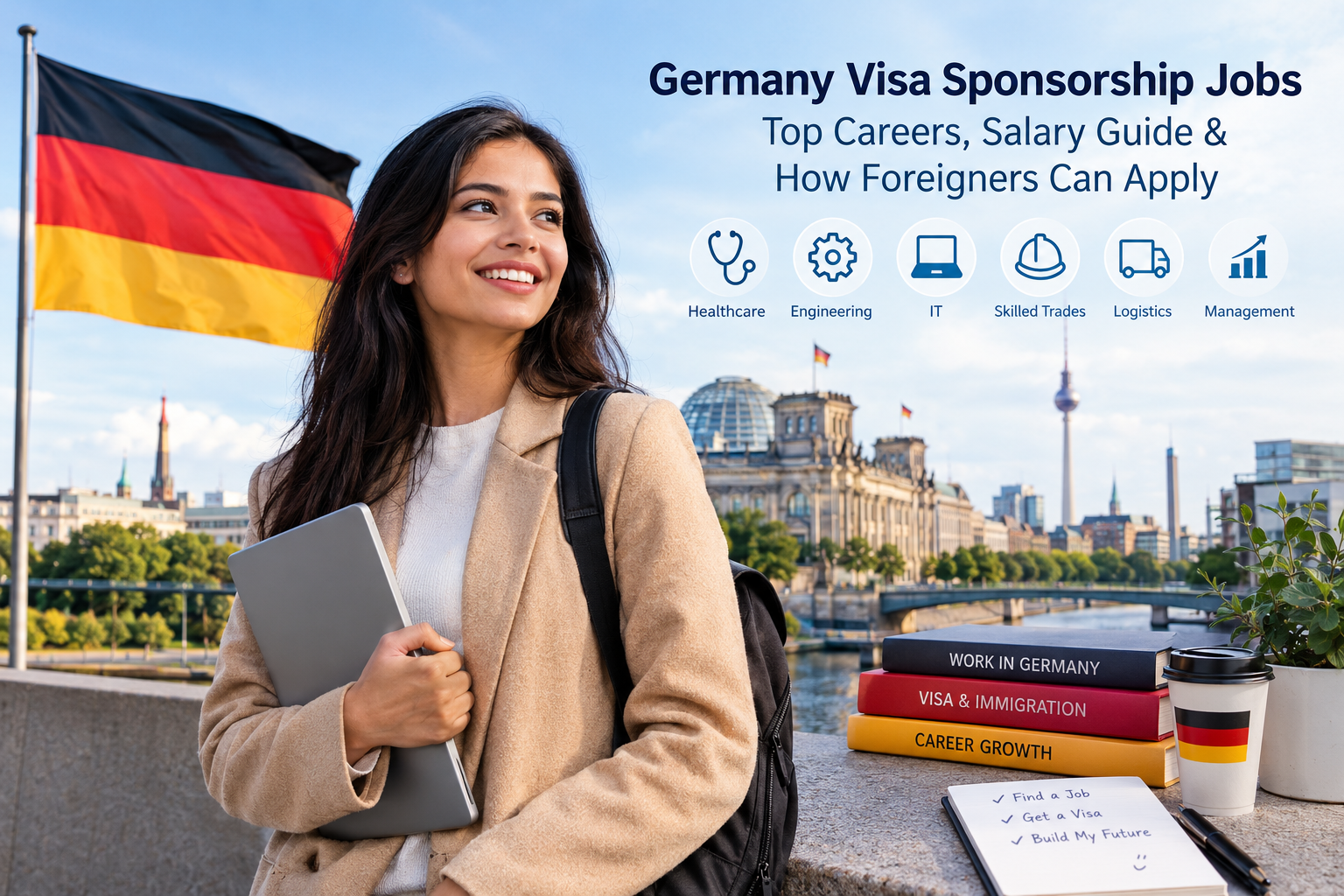
Germany continues to attract international workers who want access to a strong industrial economy, modern workplaces, professional development, and opportunities for long-term residence. For job seekers living outside Europe, the country offers potential career paths in healthcare, engineering, information technology, logistics, manufacturing, construction, transportation, and other skilled occupations.
However, finding employment in Germany from abroad requires more than identifying a vacancy with an attractive salary. Applicants must understand the German work visa system, check whether their qualifications are accepted, and identify employers willing to recruit internationally. The requirements also differ depending on the occupation, salary, professional qualifications, and type of residence permit.
In 2026, qualified professionals can explore several immigration routes, including the EU Blue Card and residence permits for skilled workers. Germany also offers opportunities for certain applicants with vocational qualifications or substantial practical experience. The country’s official immigration information explains these different routes and their requirements.
For foreign applicants, the best approach is to focus on genuine vacancies, realistic salary expectations, and employers that can support the necessary recruitment and immigration process.
This guide explains where to look for Germany visa sponsorship jobs in 2026, which careers may offer competitive salaries, what applicants need before applying, and how to prepare a stronger application.
Why Consider Working in Germany in 2026?
Germany has a diverse economy supported by manufacturing, engineering, automotive production, healthcare, scientific research, logistics, construction, and digital technology. International employees already contribute to many of these sectors.
According to Germany’s Federal Employment Agency, its 2025 labour-market analysis identified 157 occupational categories experiencing skills shortages. Healthcare and care work, construction, skilled trades, professional driving, and early-childhood education were among the areas highlighted in its September 2026 update. This does not mean every vacancy is open to overseas applicants, but it demonstrates why international recruitment remains important in several parts of the economy.
Germany’s official skilled-worker portal also identifies healthcare professionals, doctors, engineers, IT specialists, scientists, craftspeople, and transport professionals as areas worth exploring.
Foreign workers may benefit from several features of the German employment market:
- Competitive professional salaries: Experienced specialists and managers can earn attractive gross annual incomes, depending on their occupation and employer.
- Established industries: Germany has extensive industrial, automotive, engineering, pharmaceutical, and logistics operations.
- Structured employment: Many employers provide written contracts, defined responsibilities, and formal employment benefits.
- Professional development: Employees may have access to technical training, further qualifications, and career progression.
- Legal immigration pathways: Eligible applicants can use employment-based residence permits to work legally.
- Potential long-term residence: Certain residence permits allow qualified workers to apply for permanent residence after meeting the relevant conditions.
Nevertheless, Germany is not an automatic route to a high salary. Housing, transport, insurance, income tax, social security contributions, and living expenses affect the amount an employee can save.
What Are Germany Visa Sponsorship Jobs?
Germany visa sponsorship jobs are vacancies offered to international candidates who require permission to live and work in Germany.
The phrase is commonly used by job seekers to describe employers willing to recruit candidates from other countries and provide the documentation or assistance needed for an employment-based immigration application.
In Germany, the process does not always work like sponsorship systems in countries where employers must obtain a separate sponsorship licence. Depending on the immigration route, the employer may provide a signed employment contract, job description, salary details, and supporting documents, while the applicant submits the required visa or residence-permit application.
Some employers actively recruit internationally and have established relocation procedures. Others may consider overseas candidates but expect them to manage much of the immigration process themselves.
Before applying, candidates should confirm:
- Whether the employer accepts applicants living outside Germany.
- Whether the vacancy is available to non-EU nationals.
- Whether the position qualifies for the relevant work permit.
- Whether the salary meets the applicable immigration threshold, if one applies.
- Whether the employer assists with documentation, relocation, or accommodation.
- Whether the applicant’s education, vocational training, or experience meets the job requirements.
A job advertisement mentioning international recruitment does not guarantee visa approval. The final decision depends on the applicable immigration rules and the applicant’s circumstances.
Highest-Paying Jobs in Germany for Foreign Workers
The highest salaries are generally associated with specialist expertise, professional qualifications, extensive experience, leadership responsibilities, and industries where employers compete for highly skilled employees.
Foreign candidates should distinguish between realistic professional salary ranges and exceptional compensation packages advertised for senior executives or other rare positions.
The following table provides illustrative gross annual salary ranges for career planning. These figures are indicative estimates, not verified salary offers for particular vacancies, and they are not official government salary scales. Actual compensation can be lower or higher depending on experience, location, company size, industry, and contract terms.
Germany Jobs and Estimated Annual Salaries in 2026
| Job position | Illustrative annual gross salary | Potential sector |
|---|---|---|
| Chief Executive Officer (CEO) | €120,000–€350,000+ | Corporate management |
| Specialist Medical Doctor | €80,000–€180,000+ | Healthcare |
| IT Director or Technology Executive | €100,000–€200,000+ | Technology |
| Senior Software Engineer | €65,000–€110,000 | Software and digital services |
| Artificial Intelligence Engineer | €65,000–€120,000 | AI and data technology |
| Engineering Manager | €75,000–€130,000 | Manufacturing and engineering |
| Senior Automotive Engineer | €65,000–€105,000 | Automotive industry |
| Pharmaceutical Research Scientist | €55,000–€100,000 | Life sciences |
| Data Scientist | €55,000–€95,000 | Data analytics |
| Electrical Engineer | €50,000–€85,000 | Industrial engineering |
| Mechanical Engineer | €48,000–€82,000 | Manufacturing |
| Registered or Qualified Nurse | €38,000–€58,000 | Healthcare |
| Qualified Logistics Manager | €45,000–€80,000 | Supply chain |
| Experienced Heavy Goods Vehicle Driver | €32,000–€50,000 | Transportation |
| Skilled Industrial Technician | €38,000–€60,000 | Manufacturing |
| Qualified Construction Worker | €32,000–€50,000 | Construction |
| Warehouse Operative | €26,000–€36,000 | Warehousing |
| Hotel or Restaurant Professional | €25,000–€38,000 | Hospitality |
Salary figures are broad estimates for comparison, not guarantees or confirmed offers. CEO and executive compensation may include bonuses, stock awards, or other benefits, making direct comparisons with ordinary employee salaries difficult. Warehouse, driving, and hospitality earnings vary with working hours, overtime, qualifications, and employer.
The table illustrates an important point: a salary of €350,000 annually is possible in certain exceptional executive positions, but it should not be presented as a normal salary for international workers or as a typical outcome of obtaining visa sponsorship.
For many qualified applicants, a suitable job paying €40,000–€80,000 annually may provide a more realistic starting point, depending on their occupation and experience.
1. Healthcare and Nursing Jobs
Healthcare is one of the most important sectors for internationally trained workers considering Germany. Hospitals, care facilities, rehabilitation centres, and other healthcare providers employ professionals with a wide range of qualifications.
Potential positions include registered nurses, specialist nurses, medical doctors, physiotherapists, radiographers, and certain healthcare technicians.
Why healthcare workers should consider Germany
Germany’s ageing population and the ongoing need for healthcare services create demand for qualified personnel. The Federal Employment Agency has also highlighted healthcare and care occupations among the areas experiencing significant labour shortages.
However, healthcare is a regulated field. Overseas applicants may need recognition of their professional qualifications, proof of language proficiency, and permission to practise in the relevant occupation.
For nursing positions, German-language skills are particularly important because employees must communicate with patients, colleagues, and healthcare authorities. The exact language requirement depends on the role and the relevant state regulations.
Doctors generally need recognition of their medical qualifications and the appropriate professional licence. Applicants should investigate these requirements before accepting an offer.
How to apply
Search for international nursing recruitment programmes, hospital career pages, recognised healthcare recruitment agencies, and the official German skilled-worker portal.
Look for vacancies that clearly explain whether the employer accepts applicants trained abroad and whether it provides language courses, qualification-recognition assistance, or relocation support.
Healthcare candidates should prepare their qualifications, employment references, professional registration documents, and language certificates where applicable.
2. Software Development and Information Technology
Information technology remains an attractive career field for applicants with practical digital skills, relevant education, or a strong professional portfolio.
Potential positions include software developers, cloud engineers, cybersecurity specialists, IT consultants, database administrators, data engineers, and artificial intelligence specialists.
Employers may be found in technology companies, financial services, industrial automation, e-commerce, telecommunications, and established manufacturing businesses.
Skills employers may look for
Depending on the vacancy, relevant skills can include:
- Java, Python, JavaScript, C++, or other programming languages.
- Cloud infrastructure and deployment.
- Cybersecurity, identity management, and network administration.
- Data engineering, machine learning, and artificial intelligence.
- Software testing and quality assurance.
- Database management and system integration.
Applicants should match their CV to the actual requirements instead of listing every technology they have encountered.
A portfolio showing completed projects, links to professional work, and measurable achievements can help demonstrate practical ability.
Can IT professionals qualify without a university degree?
In some cases, yes. Germany provides a special EU Blue Card route for certain experienced IT professionals who do not hold a formal university qualification.
Under the 2026 rules, eligible applicants generally need a qualifying German IT job offer lasting at least six months, at least three years of relevant IT experience during the preceding seven years, and a gross annual salary of at least €45,934.20. Other eligibility conditions apply, and the employment terms may require review by the Federal Employment Agency.
This route is not an exemption from all immigration requirements. Applicants must check the full criteria before relying on it.
3. Engineering and Manufacturing Careers
Germany has a substantial industrial base, creating opportunities for engineers and technical specialists across manufacturing, automotive production, machinery, electrical systems, and industrial automation.
Potential roles include mechanical engineers, electrical engineers, robotics engineers, production engineers, quality engineers, automotive engineers, and industrial automation specialists.
The official German skilled-worker portal highlights engineering as an important career area. Its published industry information also reports substantial employment of foreign engineers and significant engineering vacancies in 2025.
Skills that can strengthen an application
Employers may value experience with computer-aided design, industrial automation, quality control, maintenance planning, production systems, technical documentation, or project management.
The most relevant skills depend on the employer’s products and equipment.
For example, an automotive manufacturer may prioritise experience with production processes, vehicle electronics, or quality assurance. An energy company may focus on electrical systems, renewable energy technologies, and safety procedures.
Candidates with recognised engineering degrees and relevant professional experience should search for vacancies that explicitly accept international applications.
Some roles may require recognition of qualifications or additional professional authorisation. Candidates should check these requirements before relocating.
4. Construction and Skilled Trades
Construction and skilled trades offer another possible route for foreign workers, particularly those with practical experience and recognised vocational training.
Potential occupations include electricians, plumbers, welders, HVAC technicians, industrial mechanics, carpenters, and experienced construction specialists.
Germany’s Federal Employment Agency identified shortages in construction and skilled trades in its 2026 analysis. However, employers still assess candidates according to their technical competence, qualifications, language ability, and suitability for the specific work.
What employers may require
Depending on the position, applicants may need vocational certificates, evidence of apprenticeship training, previous employment references, technical assessments, or knowledge of German workplace safety procedures.
Some occupations are regulated or require particular authorisations. Others may be accessible through different skilled-worker routes, depending on the applicant’s qualifications and immigration category.
Applicants should not assume that every trade job automatically qualifies for a work visa. They should first confirm the immigration route available for their particular occupation.
A well-prepared application should explain the types of equipment used, projects completed, safety procedures followed, and relevant technical experience.
5. Logistics, Warehousing, and Supply Chain Jobs
Germany’s manufacturing, retail, and distribution industries depend on the movement and storage of goods. This creates a broad employment market covering warehouse operations, inventory management, order preparation, transport planning, and supply chain coordination.
Potential positions include warehouse supervisors, logistics coordinators, inventory controllers, forklift operators, distribution planners, and supply chain managers.
Which logistics roles are most suitable for overseas applicants?
Candidates with professional qualifications or supervisory experience may find stronger immigration options in logistics management, distribution planning, or specialist supply chain positions than in basic warehouse work.
Entry-level warehouse jobs also exist, but a vacancy does not automatically qualify an overseas applicant for an employment-based residence permit. Eligibility depends on the particular immigration route, the role, the applicant’s background, and any applicable labour-market requirements.
Applicants should be particularly cautious about advertisements promising guaranteed German work visas for unskilled warehouse jobs without explaining the legal basis.
Useful experience includes stock control, warehouse management systems, barcode scanning, order fulfilment, dispatch documentation, loading and unloading procedures, and workplace safety.
If you hold a recognised forklift licence, include it in your application and confirm whether additional German certification or training is necessary.
6. Professional Driving and Transportation Jobs
Professional drivers support Germany’s freight, passenger transport, and distribution networks. Opportunities may include heavy goods vehicle drivers, bus drivers, delivery drivers, and certain specialised transport operators.
The Federal Employment Agency’s 2026 labour-market update identified professional driving among occupations for which workers are being sought.
However, overseas candidates need to check licensing requirements carefully. A driving licence issued in another country may not automatically authorise the holder to perform professional driving work in Germany.
Depending on the job, applicants may need an appropriate driving category, professional driver qualification, medical fitness documentation, and additional training or licence conversion.
Candidates should also check whether the employer recruits drivers from outside the European Union and whether it offers support with the required qualifications.
A genuine offer should clearly state the vehicle category, working hours, gross salary, overtime arrangements, accommodation terms if offered, and the steps required before driving duties can begin.
7. Finance, Business, and Management Positions
Germany also offers opportunities in finance, consulting, banking, business operations, procurement, and corporate management.
Potential positions include financial analysts, accountants, risk specialists, procurement managers, business consultants, operations managers, and senior executives.
The highest compensation is generally concentrated in senior positions requiring substantial experience, specialist expertise, or responsibility for major teams and business operations.
Applicants should distinguish between an advertised maximum salary and the compensation normally offered to employees in a particular occupation.
For finance and management positions, employers may prioritise relevant qualifications, professional certifications, knowledge of financial reporting, experience with enterprise software, and familiarity with German or European business regulations.
German-language ability may be essential for roles involving local clients, tax matters, compliance, or domestic financial reporting. International companies may offer some positions where English is the main working language.
8. Scientific Research and Pharmaceutical Careers
Germany’s pharmaceutical, biotechnology, chemical, medical technology, and research industries offer potential opportunities for qualified scientists.
Possible positions include research scientists, laboratory specialists, biotechnologists, pharmaceutical development professionals, clinical research associates, and scientific data analysts.
Applicants with postgraduate qualifications or experience in specialised research may be suited to university laboratories, research institutes, pharmaceutical companies, and private research organisations.
Before applying, candidates should examine whether the role requires a particular academic degree, laboratory certification, knowledge of regulatory standards, or experience with specialised equipment.
Research positions can also differ in employment conditions. A funded research project, a university appointment, and a permanent pharmaceutical industry position may offer very different salaries and contract terms.
Applicants should therefore compare the full contract rather than focusing only on the advertised annual figure.
Understanding Germany’s Work Visa Options in 2026
A job offer is an important part of many employment-based immigration routes, but the correct residence permit depends on the applicant’s circumstances.
Germany’s official immigration guidance describes several options for qualified foreign workers. The following are among the most relevant routes to investigate.
EU Blue Card
The EU Blue Card is intended for eligible highly qualified professionals who have a qualifying job offer and meet the applicable requirements.
For 2026, the official gross annual salary thresholds are:
| EU Blue Card category | Minimum gross annual salary |
|---|---|
| Standard category | €50,700 |
| Eligible shortage occupations | €45,934.20 |
| Eligible recent graduates | €45,934.20 |
| Eligible experienced IT professionals without a degree | €45,934.20 |
The lower threshold is available only to eligible applicants under the applicable rules. The job must also meet the other requirements for the particular category. Certain cases require approval from the Federal Employment Agency.
These figures are official 2026 thresholds, not average salaries and not the minimum wage for all German employment.
The EU Blue Card may offer advantages for eligible workers, including certain family-reunification provisions and a route to settlement after a qualifying period. The actual conditions depend on the applicable rules and the applicant’s circumstances.
Skilled worker residence permit
Germany also provides residence permits for qualified workers with recognised vocational qualifications or eligible academic credentials.
Applicants generally need a qualifying job offer and must satisfy the conditions for the relevant immigration category.
For regulated professions, such as certain healthcare occupations, professional recognition or a licence to practise may be necessary.
Visa for professionally experienced workers
Certain applicants may qualify through routes designed for workers with substantial practical experience, even where the standard recognition pathway is not the same as that used for fully recognised qualifications.
These routes have specific conditions concerning work experience, qualifications, job offers, salary, and occupation. Applicants should use the official immigration guidance to determine whether their particular situation qualifies.
Opportunity Card
The Opportunity Card, also known as the Chancenkarte, is a separate option for eligible people who want to enter Germany to look for work.
It is not the same as an employer-sponsored work permit. Eligibility and financial requirements apply, and obtaining the card does not guarantee employment or automatically authorise unrestricted full-time work.
People considering this route should check the current official conditions before travelling.
Official immigration guidance: https://www.make-it-in-germany.com/en/visa-residence/skilled-immigration-act
Salary Expectations: What Does a German Job Offer Really Mean?
When comparing Germany visa sponsorship jobs, applicants should focus on the actual employment contract rather than the highest salary displayed in a headline.
Most salary figures in German job advertisements refer to gross earnings before deductions.
For example, a gross salary of €60,000 per year equals €5,000 per month before tax and other deductions, assuming the salary is paid evenly across 12 months.
The employee’s take-home pay will depend on individual circumstances, including income tax, social insurance contributions, health insurance arrangements, and other applicable factors.
Other considerations include:
- Location: Housing and everyday expenses differ between German cities and regions.
- Experience: Senior employees may earn more than new entrants.
- Working hours: Some roles involve shifts, overtime, weekend duties, or night work.
- Bonuses: Performance-related payments may be conditional rather than guaranteed.
- Accommodation: Employer-provided housing may be free, subsidised, or deducted from wages.
- Relocation expenses: Some employers cover travel or relocation costs, while others do not.
- Contract security: Permanent employment and fixed-term project contracts offer different levels of continuity.
Before accepting a position, request a written explanation of the salary, payment schedule, working hours, probation period, leave entitlement, deductions, and any relocation benefits.
Where to Find Germany Visa Sponsorship Jobs in 2026
The best starting point is to search platforms that provide real vacancies, clear employer information, and useful details about the qualifications required.
1. Make it in Germany
Website: https://www.make-it-in-germany.com/
This is the German government’s official portal for qualified international professionals. It provides information about employment opportunities, visa categories, qualification recognition, and working and living in Germany.
Applicants can use the website to understand which immigration route may fit their circumstances and explore the job listings available through its services.
2. Federal Employment Agency
Website: https://www.arbeitsagentur.de/
Germany’s Federal Employment Agency provides employment services and access to job listings. Search by occupation, location, qualifications, and other relevant criteria.
Candidates should check individual advertisements to determine whether employers accept applications from outside Germany.
3. LinkedIn Jobs
Website: https://www.linkedin.com/jobs/
LinkedIn is useful for searching professional positions, particularly in engineering, technology, healthcare management, finance, and corporate operations.
Try search terms such as “international applicants Germany”, “relocation support Germany”, and “visa support software engineer Germany”. These phrases can help identify relevant vacancies, but the employer must confirm its actual immigration policy.
4. EURES
Website: https://eures.europa.eu/
EURES is the European employment services network. It provides job-search resources and information about working in European countries.
Some vacancies and services are particularly relevant to people already entitled to work in Europe, so applicants outside the EU should verify eligibility for each position.
5. Company career websites
Direct applications can be especially useful when a candidate has identified an employer that recruits internationally.
Look for careers pages belonging to hospitals, engineering companies, technology businesses, manufacturers, logistics operators, and research organisations.
Search for vacancies that mention international recruitment, relocation assistance, English-language working environments, or support for professional qualification recognition.
Do not assume that every large German company sponsors every position. Review the specific advertisement and contact the recruitment team when necessary.
Step-by-Step Guide to Applying for Germany Visa Sponsorship Jobs
A well-organised application can help an overseas candidate avoid unnecessary delays and focus on employers that are genuinely recruiting.
Step 1: Select a suitable occupation
Start by choosing a job that matches your education, training, experience, and practical skills.
For example, an experienced software developer should prioritise relevant IT vacancies rather than applying indiscriminately to unrelated roles. A trained nurse should investigate healthcare employers that recruit internationally and understand professional recognition requirements.
The more closely your background matches the vacancy, the easier it is to demonstrate your suitability.
Step 2: Check the immigration requirements
Before submitting applications, identify the work permit or residence permit that may apply to your circumstances.
Check whether the position requires a university degree, vocational qualification, professional licence, minimum salary, or particular work experience.
For regulated occupations, investigate the recognition process early. A promising job offer may not be enough if you cannot meet the professional licensing requirements.
Step 3: Prepare a German-style CV
Your CV should be clear, professional, and tailored to the role.
Include your contact information, employment history, education, technical skills, relevant certificates, and language abilities. Explain your responsibilities and achievements rather than simply listing job titles.
For example, a warehouse candidate might highlight inventory control, order preparation, stock accuracy, and experience with warehouse management systems.
An engineering applicant could emphasise project delivery, technical systems, quality assurance, and relevant software tools.
Include your current country of residence when useful, and state your willingness to relocate if that is your intention.
Step 4: Write a targeted cover letter
A cover letter should explain why you are applying, how your experience matches the position, and what you can contribute to the employer.
If you are applying from abroad, you can briefly state that you are seeking an opportunity to relocate to Germany and will require the appropriate employment-based immigration authorisation.
Avoid lengthy personal stories that do not demonstrate your suitability. Focus on relevant experience, qualifications, and practical value.
Step 5: Apply through genuine channels
Submit your CV through the employer’s official careers page or the recruitment platform specified in the advertisement.
Keep a record of the company, job title, application date, contact person, and any response received.
Follow the employer’s instructions regarding supporting documents. Some may request certificates and references immediately, while others ask for them later in the recruitment process.
Step 6: Prepare for interviews
Interview questions will depend on the occupation.
Technical candidates may be asked to complete coding exercises, explain previous projects, or demonstrate their professional knowledge. Healthcare applicants may be assessed on clinical experience and communication. Skilled tradespeople may face practical assessments.
Prepare examples that show how you solved problems, worked with colleagues, followed safety procedures, and achieved results.
Ask the employer about relocation assistance, the work permit process, salary, probation, working hours, and the expected start date.
Step 7: Obtain the contract and follow the visa process
If you receive an offer, examine the employment contract carefully.
Confirm the gross salary, duties, working hours, workplace, contract duration, and any promised relocation benefits.
Use the official German immigration guidance to identify the appropriate visa or residence-permit process. Depending on the route, you may need to submit a passport, employment contract, qualifications, proof of professional recognition, insurance information, and other supporting documents.
Do not make irreversible travel arrangements until you have confirmed the entry and employment requirements applicable to you.
Documents to Prepare Before Applying
Preparing your documents in advance can make applications easier to manage.
Depending on the vacancy and immigration category, you may need:
- A valid passport.
- An updated CV and cover letter.
- Educational certificates and transcripts.
- Vocational qualifications or professional licences.
- Employment references or letters confirming work experience.
- German or English language certificates, where required.
- Qualification recognition documents, if applicable.
- A signed job offer or employment contract.
- Additional forms or supporting evidence requested by the relevant authorities.
Documents issued outside Germany may require certified translations or other formalities. Requirements vary, so check the instructions for the relevant profession and visa category rather than paying for unnecessary services.
Can Applicants from Nigeria Apply for German Jobs?
Yes. Nigerian citizens can apply for suitable German vacancies and may qualify for employment-based immigration if they meet the requirements of the relevant route.
The key consideration is not nationality alone but whether the applicant, the job, and the employment terms satisfy the applicable rules.
Nigerian applicants should focus on employers that accept international candidates, prepare accurate employment and education records, and confirm any professional recognition requirements before proceeding.
Language skills can make a significant difference. Some technology positions operate primarily in English, while many healthcare, customer-facing, construction, and administrative roles require German proficiency.
Applicants should also budget for legitimate application expenses, document preparation, language training where necessary, travel, and initial living costs.
An employer may offer relocation assistance, but candidates should never assume that airfare, accommodation, or visa fees will automatically be covered.
How to Avoid Fake Germany Visa Sponsorship Offers
International job seekers can be vulnerable to fraudulent recruitment advertisements, especially when the offer promises unusually high earnings with little experience or no relevant qualifications.
Use these precautions before paying money or sharing sensitive documents.
Be suspicious of guaranteed visas. No recruitment agent can guarantee that German authorities will approve a visa.
Verify the employer. Check the company’s official website, business details, contact information, and published vacancies. Where possible, contact the company through independently verified channels.
Do not pay for a guaranteed job offer. Be cautious if someone demands substantial upfront fees in exchange for a contract, work permit, or supposed government approval.
Read the employment contract. Confirm the job title, salary, working hours, employer identity, workplace, and any accommodation deductions.
Check salary claims. An advertisement offering €15,000 monthly for an ordinary warehouse job should be investigated carefully. High compensation is possible in certain specialist and executive positions, but extravagant promises are not proof of legitimacy.
Use official immigration information. Verify the visa route and documentation requirements through the German government’s official immigration portal and the appropriate German mission.
Protect your documents. Share passport copies and other personal information only when there is a legitimate recruitment or application reason and the recipient is verified.
A genuine employer should be able to explain the recruitment process clearly and answer reasonable questions about the contract and immigration arrangements.
Frequently Asked Questions About Germany Visa Sponsorship Jobs
1. Are Germany visa sponsorship jobs available in 2026?
Yes. German employers recruit international professionals in a range of industries, including healthcare, engineering, IT, scientific research, and selected skilled trades. Availability depends on the occupation, employer, location, and candidate’s qualifications.
2. Can I get a German job without speaking German?
Some jobs, particularly in international technology companies and research environments, may use English as their main working language. However, German is important for many healthcare, construction, transport, hospitality, and customer-facing positions.
The language requirement depends on the job and, for regulated professions, any applicable licensing rules.
3. What is the minimum salary for the German EU Blue Card in 2026?
The standard minimum is €50,700 gross annually. The threshold is €45,934.20 for eligible shortage occupations and other qualifying categories, including certain recent graduates and experienced IT professionals without a university degree.
Applicants must meet the other requirements of the relevant category.
4. Can warehouse workers get visa sponsorship in Germany?
Some warehouse and logistics jobs are available, but basic warehouse employment does not automatically qualify an overseas applicant for a work permit. Eligibility depends on the specific immigration route, the role, the applicant’s qualifications, and the applicable rules.
Applicants with recognised vocational training, specialist logistics experience, or supervisory skills may have additional options worth investigating.
5. Does Germany offer jobs paying €350,000 annually?
Such compensation can occur in exceptional senior executive positions and certain specialised roles, but it is not a typical salary for foreign workers. Most applicants should compare realistic occupation-specific salary ranges and verify whether advertised compensation is guaranteed, performance-based, or inclusive of bonuses.
6. Do employers provide free accommodation?
Some employers provide accommodation, temporary housing, or relocation assistance, but these benefits are not universal. Applicants should obtain written confirmation of what is included, how long the benefit lasts, and whether any costs are deducted from wages.
7. Can I apply from outside Germany?
Yes. Eligible candidates can apply from abroad. The process usually involves securing a suitable job offer where required, meeting the conditions of the relevant immigration category, and completing the necessary application procedures.
8. Where can I check official German work visa requirements?
Start with the German government’s skilled-worker portal at https://www.make-it-in-germany.com/ and the Federal Foreign Office at https://www.auswaertiges-amt.de/.
These resources provide official information about visa categories, qualification requirements, and application procedures.
Final Thoughts: Start Your Germany Job Search Today
Germany offers potential career opportunities for international applicants in healthcare, technology, engineering, manufacturing, logistics, transportation, construction, and scientific research. However, the most suitable route depends on the candidate’s professional background and the requirements of the individual position.
Rather than applying to every vacancy advertised online, concentrate on employers that recruit internationally, prepare a strong CV, check professional recognition requirements, and confirm the relevant immigration pathway.
Start with official job-search resources, compare salary offers realistically, and verify every employer before paying recruitment fees or making travel arrangements.
Ready to explore Germany visa sponsorship jobs in 2026? Visit the official Make it in Germany website to review employment opportunities, learn about the available work visa routes, and prepare for your next career move.
A carefully planned application, relevant qualifications, and a verified job offer can put you in a stronger position to pursue employment in Germany.
Official Sources and Further Reading
- Make it in Germany — The Skilled Immigration Act
- Make it in Germany — EU Blue Card
- Make it in Germany — Professions in Demand
- Federal Employment Agency — Job Search
- EURES — European Job Mobility Portal
Editorial note: Salary ranges in this article are indicative estimates rather than verified current vacancies. Readers should check individual job advertisements, employer contracts, and official immigration requirements before making employment or relocation decisions.